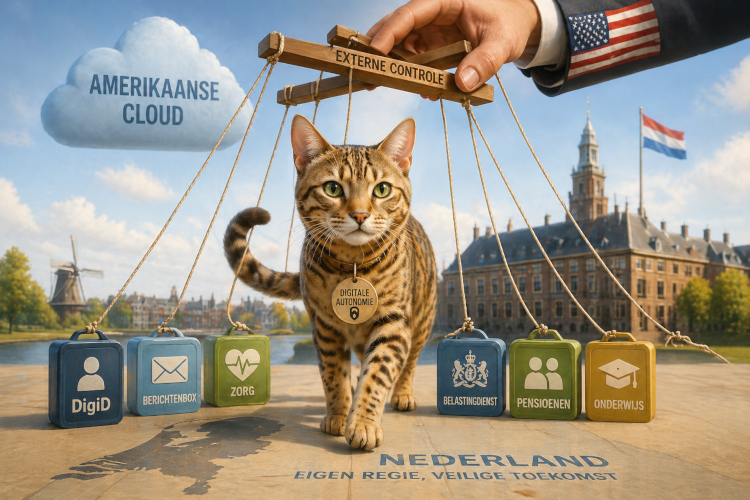
“Digital autonomy must be the starting point for the government,” the government states in the coalition agreement. A sensible course. With the recent deal with a European cloud provider, the government is taking a step in the right direction, after years of putting all data and processes in the American cloud without hesitation. However, now that Solvinity, the supplier behind the infrastructure on which DigiD and the Message Box run, is sold to investors from the United States, we are once again making our country more dependent on the American government. The Netherlands can easily put geopolitical pressure on this, for example with the threat to suspend services. The sale must therefore be stopped, argue Pieter Omtzigt, Reijer Passchier, Jesse Six Dijkstra, Ferd Grapperhaus, Marleen Stikker and Brenno de Winter.
The current US administration is using all diplomatic, economic, technological and military means to achieve its goals. It publishes public policy that it will actually do this, and then it puts it into practice. Earlier this year, the US government put heavy pressure on NATO ally Denmark to hand over Greenland to the United States and is now hinting at pressure to involve NATO allies in its war with Iran. She has ordered American software suppliers to disconnect judges and prosecutors at the International Criminal Court in The Hague from all American technology, such as e-mail and credit cards. Sanctions have also been imposed on European officials who enforce the European Digital Services Regulation (DSA).
In addition to the U.S. government being able to force any U.S. company to stop providing services in Europe through sanctions legislation or presidential decrees, under the U.S. Foreign Intelligence Act (FISA), it can also require any company to give the government access to any data under its control. For example, a cloud provider may be forced to transfer data from (European) customers and may subsequently not communicate about this externally.
In its policies and strategies, the American government explicitly states that it wants to be completely dominant in the digital world. It is already succeeding in this on the European continent and the acquisition of Solvinity only strengthens that dominance. Realize that all conceivable communication between citizens and the government takes place via DigiD or the Message Box. If these services fail, not only the Tax Authorities, the UWV and all municipalities will be stuck, but also healthcare providers, health insurers, pension funds and educational institutions: they also use DigiD for, for example, the electronic patient file or the pension overview. Changes in taxes, benefits and allowances are then no longer possible. It is also no longer possible to communicate safely with citizens, pensioners or patients.
With the threat of turning off DigiD and thus paralyzing Dutch society, the American government can put pressure on the Dutch government. This is a serious risk that we cannot ignore. Moreover, given the FISA, under which the American government may legally request information from Dutch citizens without consent or disclosure, it is conceivable that citizens will choose to no longer communicate with the government or their doctor via DigiD. Many people think of autonomy as having enough food or enough oil. For example, the Netherlands has a large strategic oil reserve to avoid immediate problems. And since the Hunger Winter, the Netherlands has always focused on producing sufficient food so that a buffer is available.
In the digital domain, this buffer is absent. If the cloud stops working, everything comes to a standstill and there is no backup system. So many systems are down at the same time that there are simply no experts to quickly get things going again with emergency facilities. In addition, if you continue to outsource all the work, you as a country will automatically lose the ICT capacity to do it yourself. We are incredibly vulnerable in this area.
We have been warned as a country: when the corona crisis had already started in China, we exported a large stock of face masks to China, without being able to make them ourselves. We should have learned by now that we need much more autonomy ourselves in case a crisis breaks out.
The number of warnings about digital dependency is almost endless. This started with a report from the Scientific Council for Government Policy in 2019. No one thinks that moving DigiD to the American cloud is a good idea, including the House of Representatives. Nevertheless, the House is passed and put on the block by the government just before this recess.
In these circumstances, the Netherlands must quickly take major steps towards greater autonomy within the EU. Until May 6, the Netherlands can make another choice and ensure that DigiD and the Message Box do not come under American control. We call on the government to do so. The timeline is short, as the decision to switch has been consistently postponed, but under pressure everything becomes fluid. The International Criminal Court also migrated to a European cloud within a few months.
After that, the government can really give substance to autonomy. To achieve this, good intentions will have to be converted into actions. This needs urgency.
Finally: Embrace contradiction from within. Civil servants who identify the risks regarding our digital autonomy and dare to put them on the agenda actually help to implement government policy.
-Dr. Pieter Omtzigt - Former Member of the House of Representatives and founder of NSC
- Prof. Dr. Reijer Passchier - Professor of Digitalization and the Democratic Rule of Law, Open University and UD Constitutional Law, Leiden University
- Jesse Six Dijkstra - Former Member of Parliament and advisor Digital Doetank
- Prof. Mr. Ferd Grapperhaus, Professor of the Rule of Law, Society and Legal Practice at Erasmus University Rotterdam
- Marleen Stikker - Founder and director Waag Future Lab
- Brenno de Winter - Cybersecurity expert and chairman of the LibreKAT Foundation
This opinion piece previously appeared in de Volkskrant.